Sunday, March 13, 2011
Review of 'Sullivan's Travels' (1941)
Sullivan's Travels opens with a fight scene atop a moving train. I liked that; grand, audacious, exciting, even by today's standards. I believe the movie maintained this standard of production and ambition throughout. It seemed like it would have been quite a blockbuster in its day, which made it very easy to watch. Road movies, too, are generally a pleasure to watch--and Sullivan’s Travels is as much an adventure films as it is comedy--because they double that effect of ‘escapism’, of the viewer being able to lose themselves in the narrative for the duration of the picture. I’m not crazy about Sullivan’s Travels but it would be a hopeless man who couldn’t enjoy it.

Tuesday, March 8, 2011
Review of The Crowd (1928)
Paul Harris' introduction to The Crowd left me eager to watch the film, expecting a slow, solemn exploration of the bleaker realities of life. While the narrative content matched my expectations--the protagonist learns the hard way that life doesn't work out the way you planned, having faced an uphill battle for his job, his money, his family, and his place in the world--the movie itself was was a melodrama instead of a thriller. I felt it was too rapidly paced and the tension too often eased with small slapstick jokes, making the film lose much of the potential emotive power in a story with such dark themes.
FTV Blog 2: Copy Shop, The Making of Collision Course
The other night my Mum invited me to sit down and watch a show she came across on ABC. It was an Australian documentary about the process of using high-speed cameras to film dancers (and wrestlers, athletes, gymnasts) performing mid-air to get super slow motion footage. The point of filming them was for the purely aesthetic beauty of the human figures moving so slowly in mid-air, but when watching this after the behind-the-scenes the effect was lost on me because the magic had already been exposed. Also, I was pre-occupied with the knowledge the dancers weren't actually doing anything natural, they had been told to 'collide like this' or 'jump like that'. Strange that the feature was a behind-the-scenes with occasional clips of the polished product. Almost always the making-of has a back seat role but then again, there is no ordinary medium in which to present these slow-mo shots. You can't have an entire TV or episode full of these shots ans nothing else. Perhaps I would have appreciated this documentary more had I already seen these slow-mo shots (apparently projected onto arts centres' exterior walls).
Interuterion by Samantha Ray
A key part of the final product (the shots, not the making-of TV show) was a Samantha Ray song called Interuterion, a deeply emotive and immersive soundscape
Copy Shop. Had no idea what that was going to be about and soon enough found myself hit with the 'what on Earth is going on?' feeling. The film didn't just engage me but demanded my attention as I became more and more desperate to understand what was happening. My impression of the ending was that in killing himself, all the copies would die too (although class consensus seemed that the suicidal man was not the original, just another copy, so the other copies would remain unaffected by his death). To interpret the plot, one analogy could be that all the copies are like voices in your head--the slight but numerous factors, experiences and beliefs that make up your conscience--and the cancerous copy men in the film are like the voices in your head if you go insane; enormous internal conflict and hysteria. So one way to end those voices is to end your entire being (suicide)--in the film, the copied men cannot exist without the original.
Stylistically, however, Copy Shop was very impressive. It was not innately pleasing to the eye (with a dirty, grey picture) but was technically brilliant. There was some clever work with the non-diegetic video, like the superimposed newspaper flicking across the frame (complete with sound effect) as we see a man reading a newspaper, or the transition between one shot and the next when the protagonist tears in half a photocopy of himself--the frame is torn down the middle to reveal an identical shot only without the character, who has accidentally made himself disappear after destroying the copy of himself. (A lazy description of the technique. Best see for yourself what I mean.)
Wednesday, March 2, 2011
FTV Blog 1: Distant Relatives, Spellbound
In the past week I've been doing some listening to Distant Relatives, an joint album by New York hip hop veteran Nas and Jamaican reggae/rapper Damian Marley. Musically it stounds out for its beats & backing vocals, both borrowing African elements, but where it truly distinguishes itself is by the themes it explores, dropping stereotypical hip hop's tribal and materialistic allusions to sex, fame and fortune in favour of deeper wisdom and moral questions such as having grace before desire (Count Your Blessings), valuing strength of character (Friends), and the troubling nature of man's existence (Patience).
 Arguably most rap already involves these ideas only in much cruder lyrics. In fact, on the track Friends, Nas' lyric 'real men, we have a code of ethics, no questions / no jealousy, no feminine tendencies...' is instantly comparable to the Jay-Z line 'males shouldn't be jealous, that's a female trait' (track Heart of the City, album The Blueprint). While both exhibit rappers' supposed chauvism when read out of context, Jay-Z is easier to criticize because his sound is very commercial and he's had tremendous mainstream success, putting him in the firing line for hip hop skeptics to label him as just another sexist rapper. Nas, in contrast, sounds more respectable because he and Marley are not ashamed to speak openly about their values with sensitivity and sentiment. They would be unfashionably saccharine if they weren't already highly respected musicians.
I watched Spellbound on Friday night, the American documentary that follows a handful of children before then during the National Spelling Bee. I watched it about ten years ago when it came out in cinemas and absolutely loved it. I suppose the filmmaker did his job; I got caught up in the drama of the spelling bee, I was completely engaged with the story and rode all the bumps with the characters.
This time I watched it I still enjoyed it but acknkowledged it was occasionally dull, such as the early scenes in rural Texas. I realised that the most recent thing I watched from this part of Texas was Friday Night Lights, which involves the punishment & glory of emotionally charged high-stakes football; a rather contrasting genre to a spelling bee (but arguably no more dramatic for its protagonists than Spellbound, in its own way). I noted this with amusement but with equal measure of wariness I also avoided drawing parallels about the way I've changed over the past ten years.
Arguably most rap already involves these ideas only in much cruder lyrics. In fact, on the track Friends, Nas' lyric 'real men, we have a code of ethics, no questions / no jealousy, no feminine tendencies...' is instantly comparable to the Jay-Z line 'males shouldn't be jealous, that's a female trait' (track Heart of the City, album The Blueprint). While both exhibit rappers' supposed chauvism when read out of context, Jay-Z is easier to criticize because his sound is very commercial and he's had tremendous mainstream success, putting him in the firing line for hip hop skeptics to label him as just another sexist rapper. Nas, in contrast, sounds more respectable because he and Marley are not ashamed to speak openly about their values with sensitivity and sentiment. They would be unfashionably saccharine if they weren't already highly respected musicians.I watched Spellbound on Friday night, the American documentary that follows a handful of children before then during the National Spelling Bee. I watched it about ten years ago when it came out in cinemas and absolutely loved it. I suppose the filmmaker did his job; I got caught up in the drama of the spelling bee, I was completely engaged with the story and rode all the bumps with the characters.
This time I watched it I still enjoyed it but acknkowledged it was occasionally dull, such as the early scenes in rural Texas. I realised that the most recent thing I watched from this part of Texas was Friday Night Lights, which involves the punishment & glory of emotionally charged high-stakes football; a rather contrasting genre to a spelling bee (but arguably no more dramatic for its protagonists than Spellbound, in its own way). I noted this with amusement but with equal measure of wariness I also avoided drawing parallels about the way I've changed over the past ten years.
Tuesday, July 13, 2010
Worst TV ads from the 2010 World Cup
In the very first ad break of SBS's coverage of the opening ceremony, I realised that these ads would be repeated countless times until the end of the World Cup. Thankfully there were some good ones but we just got sick of the majority. Of course, the World Cup is the best possible time to advertise, so companies queue in abundance to make embarrassingly desperate links between their products and football. Here's my run-through of those that were memorable for the wrong reasons:
- A cheaply animated kangaroo plays football before a stadium crowd that makes that in EA's FIFA Soccer '95 look realistic. As if the animation wasn't bad enough, the grotesque 'roo claims that "Even when the football's on the other side of the world...with TAB Sportsbet, it's almost as good as being there!"


It's enough to make you sick. TAB Sportsbet have offered us some truly disgusting ads in the past, so at least they're consistent. Interestingly, this kangaroo is playing with a football that's clearly an official Nike design (the ad even flashes the logo), so they must have bought rights to use the image. It's as if they think that will save the ad. And that makes me sick. Cheap, nasty, disastrous.
- A football match is being played inside a car tyre (bare with me). After a spectacular scissor kick shot on goal, an opposition fan screams "STOP!" and the ball stops mid-air, with the stadium watching. The voice-over laments, "if only everything stopped as quickly as tyres from Continental."
Wait, what? Now the video itself is decent, with attractive visuals and impressive special effects, but it's such a bizarre link between football and car tyres. Even more baffling is the way they've chosen to make that link--a ball stops mid-air? Huh? Watch below to be perplexed.
- Visa follows the trend of making irrelevant references to football as they dish up a simple-but-effective montage of fans around the world watching the football. It's beautiful, and has the music to match, but the voice-over ruins the moment with reprehensibly clichéd lines like, "every four years...for 31 days...the world comes together...to stand apart." We've heard it all before, and we can bear hearing it again, but then he says, jarringly, "express your true colours with an easier way to pay."
- Kia Motors is just as bad when they drive cars around a cement-covered football pitch. The supposed link is this: "it's not every day you see this kind of performance and
 handling--before the match even kicks off." Then grass appears and stands pop up, with hundreds of fans flocking to them and the streets. It's similar to (but far worse than) Hyundai's effort: thousands of fans fill a city square, playing with giant beach balls stitched as the unmistakable truncated icosahedron (right), adorning the Hyundai logo. It's quite abstract but easily excusable given it doesn't insult the viewer with absurd claims.

The final, most threatening contender for the World Cup's worst ad is an absolute catastrophe fronted by Grey's Anatomy actor Patrick Dempsey (below). He sits down at a cafe with friends, all of whom are more than happy  to indulge their friend's ego by marvelling at his good looks. Dempsey, not the modest type, responds with a revoltingly smug look before explaining to the viewer that he's using a L'Oréal hair product. It sure is awful, but its saving grace is that it's so fun to loathe Dempsey--you don't mind watching it because you love to hate it.
Watching the Tab Sportsbet ad, however, is pure misery and torment. Distress to look at, torture to hear, it is undoubtedly the most terrible advertisement from SBS's World Cup coverage.
As for the best ad, that honour is justly awarded to Nike for their Write the Future campaign. The series features world football stars in pivotal moments during fictional matches, imagining the consequences of their deeds in that moment and acting accordingly (writing their own future). There are also appearances by stars outside of football, like Roger Federer, Kobe Bryant and even Homer Simpson. Click here to watch the in its full, three-minute excellence.
Finally, talk of football ads cannot go without mention of that (above) starring Cristiano Ronaldo for Castrol Edge. It's gained a cult following thanks to Ronaldo's amusing interpretation of the English script.
 to indulge their friend's ego by marvelling at his good looks. Dempsey, not the modest type, responds with a revoltingly smug look before explaining to the viewer that he's using a L'Oréal hair product. It sure is awful, but its saving grace is that it's so fun to loathe Dempsey--you don't mind watching it because you love to hate it.
Watching the Tab Sportsbet ad, however, is pure misery and torment. Distress to look at, torture to hear, it is undoubtedly the most terrible advertisement from SBS's World Cup coverage.
As for the best ad, that honour is justly awarded to Nike for their Write the Future campaign. The series features world football stars in pivotal moments during fictional matches, imagining the consequences of their deeds in that moment and acting accordingly (writing their own future). There are also appearances by stars outside of football, like Roger Federer, Kobe Bryant and even Homer Simpson. Click here to watch the in its full, three-minute excellence.
---
Finally, talk of football ads cannot go without mention of that (above) starring Cristiano Ronaldo for Castrol Edge. It's gained a cult following thanks to Ronaldo's amusing interpretation of the English script.
Wednesday, June 23, 2010
2010 World Cup stories: New Zealand
New Zealand football in 2010 is echoing that of Australia four years ago, and the two are distinctly comparable. A nation from Down Under scrapes through a qualifying play-off, ending decades of disappointment in the 'footballing wilderness' since their last appearance. Their return to the world stage does wonders for football back home, igniting fresh interest in a land where 'soccer' takes a back seat to a more grotesque code of football. During the seasons anticipating and following the World Cup, the popularity of their domestic league flourishes and crowds swell to sizes greater than ever.
Both sides' World Cup campaigns were successful beyond expectations, and while Australia made it past the group stage, New Zealand truly impressed the world, and their journey provides a better tale of 'triumph of the underdog'.
Drawn into perhaps the weakest group at the World Cup, with Italy, Paraguay and Slovakia, the All Whites were seen as one of the worst teams in South Africa. They opened their tournament versus the Slovaks, and both sides employed cautious tactics. Despite a decent New Zealand defence, Robert Vittek headed the Slovaks into the lead after 50 minutes. In a dour match, the highlight was a dramatic 93rd-minute Paul Reid header that stole a point for the All Whites. Neither side deserved to win but the draw was certainly a victory for the Kiwis.
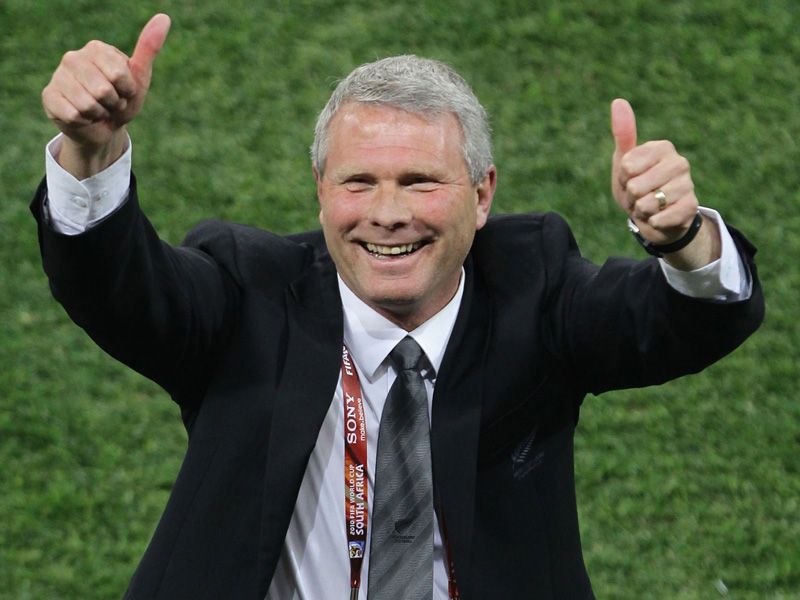
Next opponents were the Azzuri, champions of the world. Even a draw would be a mighty effort and amazingly, New Zealand scored first for an improbable 1-0 lead. Predictably, they spent the rest of the match fighting off Italian attacks, and slipped to 1-1 after a penalty given for a tug on the shirt of the physically unstable Dani de Rossi. Nevertheless, New Zealand showed 'heart' and 'spirit' and 'discipline' et al, keeping Italy at bay until the final whistle, and the result was the Cup's biggest upset so far, grabbing headlines worldwide. Late into the Italy match, Ricki Herbert (below) subbed on Andy Barron, who works full-time at a Westpac bank, playing football for semi-professional club Team Wellington in New Zealand's domestic league. Herbert admits his reason for bringing on Barron was less about tactics and more to prove that amateur footballers can mix it with big guns at the World Cup. This can hardly be proved on such little evidence, but that's missing the point. God bless Herbert, he saw the fairytale and made it happen: amateur footballers matching millionaire world champions, that's brilliant. Another way to look at it is that in Italy, there are 4.9 million footballers--more people than the entire New Zealand population.
 Needing a victory in its last match, the All Whites really should have taken the game to Paraguay, who would be safely through with one point. New Zealand were defending for hefty periods, and rarely threatened, ending in a nil-all draw. (Meanwhile, Slovakia actually defeated Italy; an even bigger upset that pushed New Zealand's into the shadows.)
Nevertheless, the World Cup was a huge success for the Kiwis. It's a great achievement to finish undefeated, not to mention, incredibly, above the world champions in the group. Interestingly, we can say that both Italy and New Zealand were winless at the World Cup, which goes to show the extreme range of expectations.
Notable trivia is that the Netherlands' loss to Spain in the final means that New Zealand were the only team to finish the World Cup undefeated. Every other team either lost at least once in the group stage or were knocked out later on--Spain, of course, lost to Switzerland in their opening match.
Both sides' World Cup campaigns were successful beyond expectations, and while Australia made it past the group stage, New Zealand truly impressed the world, and their journey provides a better tale of 'triumph of the underdog'.
Drawn into perhaps the weakest group at the World Cup, with Italy, Paraguay and Slovakia, the All Whites were seen as one of the worst teams in South Africa. They opened their tournament versus the Slovaks, and both sides employed cautious tactics. Despite a decent New Zealand defence, Robert Vittek headed the Slovaks into the lead after 50 minutes. In a dour match, the highlight was a dramatic 93rd-minute Paul Reid header that stole a point for the All Whites. Neither side deserved to win but the draw was certainly a victory for the Kiwis.
Next opponents were the Azzuri, champions of the world. Even a draw would be a mighty effort and amazingly, New Zealand scored first for an improbable 1-0 lead. Predictably, they spent the rest of the match fighting off Italian attacks, and slipped to 1-1 after a penalty given for a tug on the shirt of the physically unstable Dani de Rossi. Nevertheless, New Zealand showed 'heart' and 'spirit' and 'discipline' et al, keeping Italy at bay until the final whistle, and the result was the Cup's biggest upset so far, grabbing headlines worldwide.
 Late into the Italy match, Ricki Herbert (below) subbed on Andy Barron, who works full-time at a Westpac bank, playing football for semi-professional club Team Wellington in New Zealand's domestic league. Herbert admits his reason for bringing on Barron was less about tactics and more to prove that amateur footballers can mix it with big guns at the World Cup. This can hardly be proved on such little evidence, but that's missing the point. God bless Herbert, he saw the fairytale and made it happen: amateur footballers matching millionaire world champions, that's brilliant. Another way to look at it is that in Italy, there are 4.9 million footballers--more people than the entire New Zealand population.Needing a victory in its last match, the All Whites really should have taken the game to Paraguay, who would be safely through with one point. New Zealand were defending for hefty periods, and rarely threatened, ending in a nil-all draw. (Meanwhile, Slovakia actually defeated Italy; an even bigger upset that pushed New Zealand's into the shadows.)
Nevertheless, the World Cup was a huge success for the Kiwis. It's a great achievement to finish undefeated, not to mention, incredibly, above the world champions in the group. Interestingly, we can say that both Italy and New Zealand were winless at the World Cup, which goes to show the extreme range of expectations.
Notable trivia is that the Netherlands' loss to Spain in the final means that New Zealand were the only team to finish the World Cup undefeated. Every other team either lost at least once in the group stage or were knocked out later on--Spain, of course, lost to Switzerland in their opening match.
2010 World Cup stories: France
If England fans are feeling sorry for themselves--forever suffering under the weight of great expectation and the consequentially inevitable disappointment--then a quick glance across the Channel should ease their misery. Nobody knows the details of the French team's self-destruction but most of the football world agrees it is something truly spectacular. This summary is my understanding of the story, based on the widely reported chain of events. It includes milestones over the last 12 years in French football, which I've added to give context within the decade as well as to simplify and emphasise the highs and lows of this story:
- France wins the 1998 World Cup.
- France wins Euro 2000.
- France crashes out of the 2002 World, finishing goalless at the bottom of their group.
- France makes the final of the 2006 World Cup.
- Coach Raymond Domenech's popularity continues to fall since his 2004 appointment, despite taking Les Bleus to the final.
- France exits Euro 2008 early, winless at the bottom of their group.
- France struggles to qualify for the 2010 World Cup.
- In their opening match in South Africa, France draws nil-all with ten-man Uruguay.
- France loses 2-0 to Mexico.
- After days of rumours of unrest within the French squad, it is revealed striker Nicolas Anelka confronted Domenech at half-time versus Mexico, telling him to "go screw yourself, dirty son of a whore."
- Anelka is sent home by FFF after refusing to apologise.
- Siding with Anelka, the French players take strike in protest, walking off the training field after an argument involving Domenech, captain Patrice Evra and a fitness coach. (Details, and the remarkable video, here).
- Two members of French coaching staff quit.
- French President Nicolas Sarkozy steps in, ordering his sports minister to prolong her stay in South Africa to handle the crisis.
- Zidane is forced to deny rumours he is behind the players' rebellion. He criticises their strike, as does Domenech.
- Evra is absent at a captain-coach press conference, inciting suggestions he, and other players, will boycott the next match. Some reports even claim that four french players are threatening never to play for France again, including Evra and Thierry Henry.
- Evra is dropped for the match (pictured below, on the bench). He is criticised for poorly managing his team during the crisis, perhaps even leading the rebellion.
- France has a player sent off and are easily beaten by South Africa.
- France crashes out of the World Cup, again bottom of their group.
- Les Bleus return home a national disgrace and a laughing stock in the football world.


It is a simply remarkabe chain of events. French football is left at sixes and sevens. The fallout and investigation will continue to make headlines for months. The story of the French World Cup disaster will live on in history for much, much longer. Laurent Blanc will not believe his misfortune in falling heir to such a corrupt team--he is about to undertake one of the biggest challenges faced by any manager in the world. By contrast, his appointment could not come at a better time for the country. It marks an unparalleled chance to begin a new chapter in French football.
As for Domenech, his already dreadful esteem has managed to spiral even further down. His only saving grace is that he was already planning to part company with FFF, his contract ending after the 2010 World Cup. He could not have left on a worse note, hated by his players, hated by French fans and hated by French media. After the loss to South Africa--his final match after six years at the post--he was sincere, but it's too little too late. Nothing can save his reputation.
As my brother asserted on the whole fiasco, "they pretty much punched each other in the stomach, and it hurts."
As my brother asserted on the whole fiasco, "they pretty much punched each other in the stomach, and it hurts."
Subscribe to:
Posts (Atom)